|
|
|
|
|
|
|
|
Star map showing the path of Neptune against the background stars of Pisces, Cetus and Aries from 2024 to 2049. Positions are marked for each opposition date. Neptune describes South-facing loops throughout the period, although the individual 'loops' are not discernible in this chart because of its small scale (each loop appears as an oblique line). Because the angular width of Neptune's loops (about 2º.8 across) are greater than its annual orbital motion against the background stars, each successive loop overlaps (in longitude) with the next. The star map applies to observers in the Northern hemisphere (i.e. North is up); for the Southern hemisphere view, click here. The faintest stars shown on the map have an apparent magnitude of about +4.8. Printer-friendly versions of this chart are available for Northern and Southern hemisphere views. Astronomical co-ordinates of Right Ascension (longitude, measured Eastwards in hrs:mins from the First Point of Aries) and Declination (latitude, measured in degrees North or South of the celestial equator) are marked around the border of the chart. |
The Position of Neptune in the Night Sky:
2024 to 2049
by Martin J. Powell
Neptune entered the constellation of Pisces, the Fishes, in early May 2022, where it will be mostly positioned through to May 2039. During this 17-year period Neptune retrogrades back into Aquarius, the Water Carrier, in August 2022 and November 2023 (in the latter case for just ten days). The planet crosses the celestial equator (where the declination of a celestial body is 0°) in Pisces in April 2026 (heading North-eastwards and moving direct), in September 2026 (heading South-westwards and moving retrograde) and again in February 2027 (resuming North-easterly motion, moving direct).
|
Neptune and its brightest moon Triton imaged by Vinicius Mansano Martins (Ribeirão Preto, São Paulo, Brazil) in July 2022. Martins used an 8-inch (203mm) Newtonian reflector telescope fitted with a CMOS camera. Triton reaches magnitude +13.5 around opposition (Image: Vinicius Martins /ALPO-Japan) |
In April 2028 the planet cuts across the North-western corner of the non-zodiacal constellation of Cetus, the Whale, which it mostly occupies through to January 2031. During this time the planet retrogrades back into Pisces in October 2028 and re-enters it (moving direct) through its central Southern border in May 2029, March 2030 and January 2031.
While
in the tail region of the Northern Fish, Neptune makes
two close passes of the naked-eye star Torcular
( Psc or Omicron Piscium,
apparent
magnitude +4.2). On June 4th 2037 the planet passes just 3' (3
arcminutes, where 1 arcminute = 1/60th of
a degree) South of the star in the morning sky. Four months later, on October
1st 2037, it passes 9' (0°.15) South of the star whilst retrograding, also in
the morning sky.
Psc or Omicron Piscium,
apparent
magnitude +4.2). On June 4th 2037 the planet passes just 3' (3
arcminutes, where 1 arcminute = 1/60th of
a degree) South of the star in the morning sky. Four months later, on October
1st 2037, it passes 9' (0°.15) South of the star whilst retrograding, also in
the morning sky.
Neptune enters Aries, the Ram, in May 2039, retrograding back into the tail region of Pisces for a six-month period in October 2039. Whilst in Aries, in 2042, Neptune passes through perihelion (its closest orbital point to the Sun) at a solar distance of 29.81 Astronomical Units (4.46 thousand million kms or 2.8 thousand million miles). The planet occupies Aries for a little over 8½ years before entering Taurus, the Bull, in July 2048, retrograding back into Aries in September 2048 and December 2049. The planet re-enters Taurus for the long term in March 2050.
Neptune reaches opposition to the Sun (when it is closest to the Earth and brightest in the sky for the year) every 367½ days on average, i.e. about 2½ days later in each successive year. The apparent magnitude of the planet varies little during the period shown in the star chart: from +7.8 (at opposition) to +8.0 (at superior conjunction). Around all opposition dates shown on the star map, Neptune is due South at local midnight in the Northern hemisphere (due North at local midnight in the Southern hemisphere).
The apparent diameter of the planet (its angular size when seen from the Earth) at opposition throughout the period covered by the star chart is 2".3 (2.3 arcseconds, where 1 arcsecond = 1/3600th of a degree).
Looking further ahead, the pale-blue ice giant will continue its Northward motion along the ecliptic until it attains its most Northerly point in Gemini in 2067 - a position that it last reached in 1904.
[Terms in yellow italics are explained in greater detail in an associated article describing planetary movements in the night sky.]
Neptune Conjunctions with other Planets, 2024 to 2025
Viewed from the orbiting Earth, whenever two planets appear to pass each other in the night sky (a line-of-sight effect) the event is known as a planetary conjunction or appulse. Not all planetary conjunctions will be visible from the Earth, however, because many of them take place too close to the Sun. Furthermore, not all of them will be seen from across the world; the observers' latitude will affect the altitude (angle above the horizon) at which the two planets are seen at the time of the event and the local season will affect the sky brightness at that particular time. A flat, unobstructed horizon will normally be required to observe most of them.
The majority of conjunctions involving Neptune are not spectacular to view because the planet is never visible to the naked-eye. Twilight quickly renders the planet unobservable (even through binoculars) such that conjunctions taking place less than about 22° from the Sun are difficult or impossible to see. Since Venus is always less than 47° from the Sun and Mercury is always less than about 27° from the Sun, it follows that conjunctions of either of these inferior planets with Neptune will have a limited window of time within which they will be observable.
Because Mercury is mostly seen in twilight, the number of occasions during which it can be seen in conjunction with Neptune is limited. During the period from 2010 to 2050, for example, there are only ten occasions when Mercury is positioned more than 22° from the Sun at the moment of its conjunction with Neptune. In fact, the relationship of Mercury's eccentric orbit to that of the Earth's is such that the planet's most favourable elongations are best seen from the Southern hemisphere. Hence for the most part, Northern hemisphere observers are denied the opportunity of seeing the Sun's closest and furthest planets together in the sky.
|
|
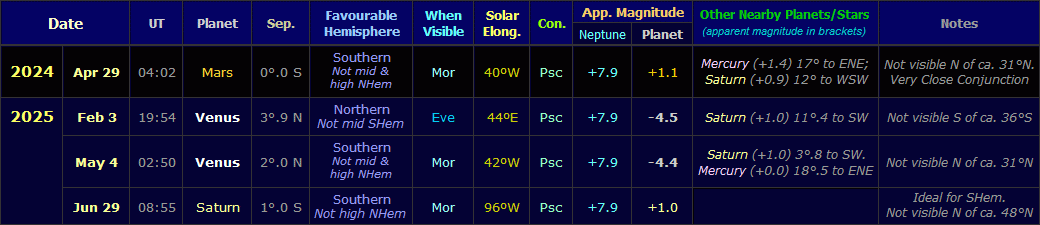
Optical aid will always be required to glimpse Neptune as a pale-blue 'star'. Even when the elongation is favourable, a further problem beckons in that the glare caused by the brighter nearby planet (Venus in particular) makes it difficult to see the much fainter planet beside it. In such instances (e.g. for the Venus-Neptune conjunctions of February and May 2025) binocular observers find it easier to position Venus just outside the binocular field of view so that Neptune may be more comfortably viewed.
The February 3rd 2025 conjunction between Venus and Neptune took place in the evening sky and was relatively favourable for Northern hemisphere observers. As Neptune came into view at nightfall, the planets were positioned 15° high in the WSW at 60° North, 23° high in the WSW at 40° North, 25° high in the WSW in the Northern Tropics and 22° high in the West at the Equator. After nightfall, the pair were observable through to setting for about 1¾ hours (from latitude 60° North), 2 hours (from 40° North), 1¾ hours (from the Northern Tropics) and 1½ hours (from the Equator). Whilst the solar elongation of the conjunction was a decent 44° (almost the maximum it can be for Venus), for Southern hemisphere observers the shallow angle of the ecliptic to the Western horizon at this time of year meant that most observers here had a poor view. At latitude 15° South the planets were positioned 16° high in the West as Neptune came into view, while at 25° South they were only 11° high in the West; from here they were only visible for about an hour (15° South) and 50 minutes (25° South) before setting.
The observational circumstances of the May 4th 2025 Venus-Neptune morning conjunction were essentially the opposite of that which took place three months earlier on February 3rd. The solar elongation of 42° was only slightly less than that of February 3rd but the fact that it took place in the morning sky meant that on this occasion it was the Southern hemisphere which had the best view. When Neptune disappeared from view at the start of dawn, the pair were positioned 21° high in the East at the Equator, 24° high in the ENE at latitude 25° South and 20° high in the ENE at 45° South. At 20° North the pair only reached 13° above the Eastern horizon at Neptune's disappearance. The pair were visible after rising for about 50 minutes (from the Northern Tropics), 1½ hours (from the Equator), 1¾ hours (from the Southern Tropics) and 2 hours (from latitude 45° South).
A conjunction with Mars on the morning of April 29th 2024 was only observable South of about latitude 31° North. At best, Southern Tropical latitudes saw the pair at 22° above the Eastern horizon when Neptune disappeared from view at first light, being visible for about 1½ hours after rising. At Northern Tropical latitudes the pair were only 10° high in the East while at mid-Southern latitudes they were around 20° high in the ENE.
Neptune's most interesting conjunctions take place when the planet is within a few months of opposition, at which times they involve the superior planets Mars, Jupiter, Saturn and Uranus; these events are rare, however. The most recent conjunction of note was between Neptune and Jupiter on December 20th 2009, when Jupiter described its significantly larger planetary 'loop' about one apparent Full Moon-diameter to the South of the outermost gas giant. It was the last of three conjunctions which took place between these planets during that year (more details can be found here). Most conjunctions between Neptune and the superior planets, however, occur at elongations of less than 90°, when Neptune is below its brightest magnitude in any given apparition. During the 2024-25 period only one observable conjunction took place at an elongation of greater than 90°, Neptune being almost magnitude +8 at every conjunction.
In terms of the ease of viewing, Neptune's morning conjunction with Saturn on June 29th 2025 was the most favourable of the 2024-25 period, though it was not observable from North of the mid-Northern hemisphere. With an angular separation in the sky of 1° (two apparent Full Moon-diameters) and a dim Saturn (magnitude +1.0) positioned far from Earth and having its rings more-or-less edgewise-on, this was a comfortable conjunction to observe, either through binoculars or telescopes. From South of the mid-Northern hemisphere it was also a leisurely one to observe, since the pair rose in darkness several hours before the Sun, being visible for 3½ hours (at 30° North), 5 hours (Equator), 5½ hours (25° South) and 6 hours (45° South) before Neptune faded from view at first light. By this time they were positioned 45° high in the South-east at 30° North, 63° high in the East at the Equator, 65° high in the North at 25° South and 45° high in the North at 45° South. At latitudes South of about 32° South the pair had passed through due North (i.e. transited the meridian) by the time dawn arrived.
Because of their sizes, their positions within the Solar System and their constituent elements, Uranus and Neptune are often considered to be planetary 'twins' and the term ice giant is often used to describe them. From the viewpoint of the Earth, faster-moving Uranus 'overtook' Neptune when the two planets were in Sagittarius in July 1993, at which point they were seen in conjunction. This was the first time these planets had been in conjunction since they were discovered (Uranus in 1781, Neptune in 1846). Conjunctions between Uranus and Neptune are rare events indeed, occurring about every 172 years; the next one will be in the year 2164.
The following table lists the conjunctions involving Neptune which took place at solar elongations of greater than 20° over the period in question. In several cases, other planets and/or stars were also in the vicinity and these are detailed.
|
Neptune conjunctions with other planets from 2024 to 2025 The column headed 'UT' is the Universal Time (equivalent to GMT) of the conjunction (in hrs : mins). The separation (column 'Sep') is the angular distance between the two planets, measured relative to Neptune, e.g. on 2025 Feb 3, Venus was positioned 3°.9 North of Neptune at the time shown. The 'Favourable Hemisphere' column shows the Hemisphere in which the conjunction was best observed. Note that observers located close to the Northern/Southern visibility boundary of any given conjunction will have found it difficult or impossible to observe because of low altitude and/or bright twilight. In the 'When Visible' column, the terms Evening/Morning refer to the period after darkness falls/before twilight begins. The 'Con' column shows the constellation in which the planets were positioned at the time of the conjunction. To find the direction in which any of the conjunctions were seen on any of the dates in the table, note down the constellation in which the planets were located ('Con' column) on the required date and find the constellation's rising direction (for Morning conjunctions) or setting direction (for Evening conjunctions) for your particular latitude in the Rise-Set direction table. |
Although any given conjunction takes place at a particular instant in time, it is worth pointing out that, because of the planets' relatively slow daily motions, such events are interesting to observe for several days both before and after the actual conjunction date.
There are in fact two methods of defining a planetary conjunction date: one is measured in Right Ascension (i.e. perpendicular to the celestial equator) and the other is measured along the ecliptic, which is inclined at 23½° to the Earth's equatorial plane (this is due to the tilt of the Earth's axis in space). An animation showing how conjunction dates are determined by each method can be found on the Jupiter-Uranus 2010-11 triple conjunction page. Although conjunctions measured along the ecliptic can be significantly closer, the Right Ascension method is the more commonly used, and it is the one which is adopted here.
|
|
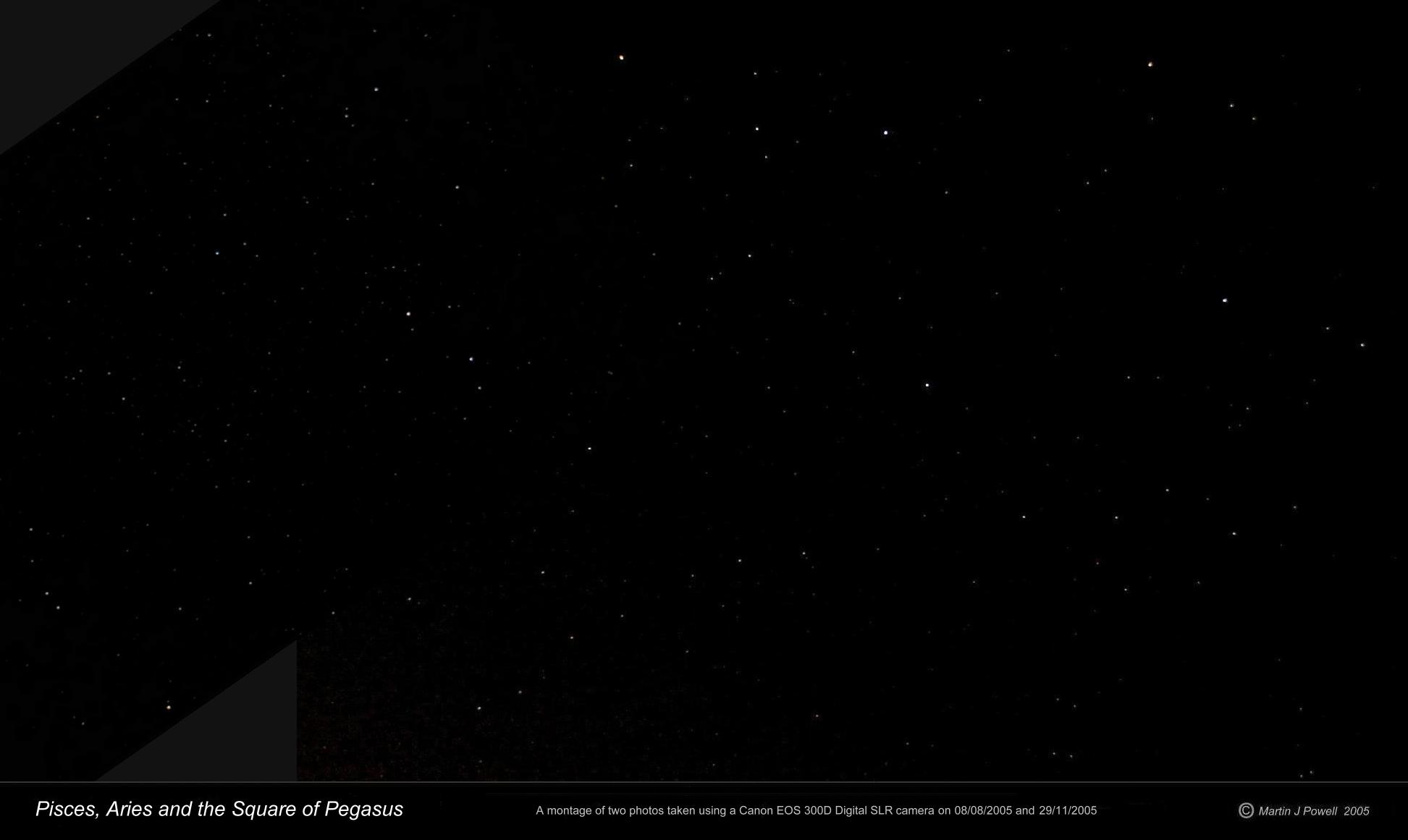
Pisces and Aries A montage of two photographs showing the region of the night sky through which Neptune passes through to 2050. Stars can be seen down to about magnitude +7 (move your pointer over the image - or click here - to see an annotated version of the photograph and click on the thumbnail to see the full-size picture) |
|
|
Finder Chart for Neptune, 2025
During 2025 Neptune was positioned in South-western Pisces, close to its border with Aquarius, the Water Carrier. It reached opposition in September, several degrees South-east of the Circlet of Pisces asterism.
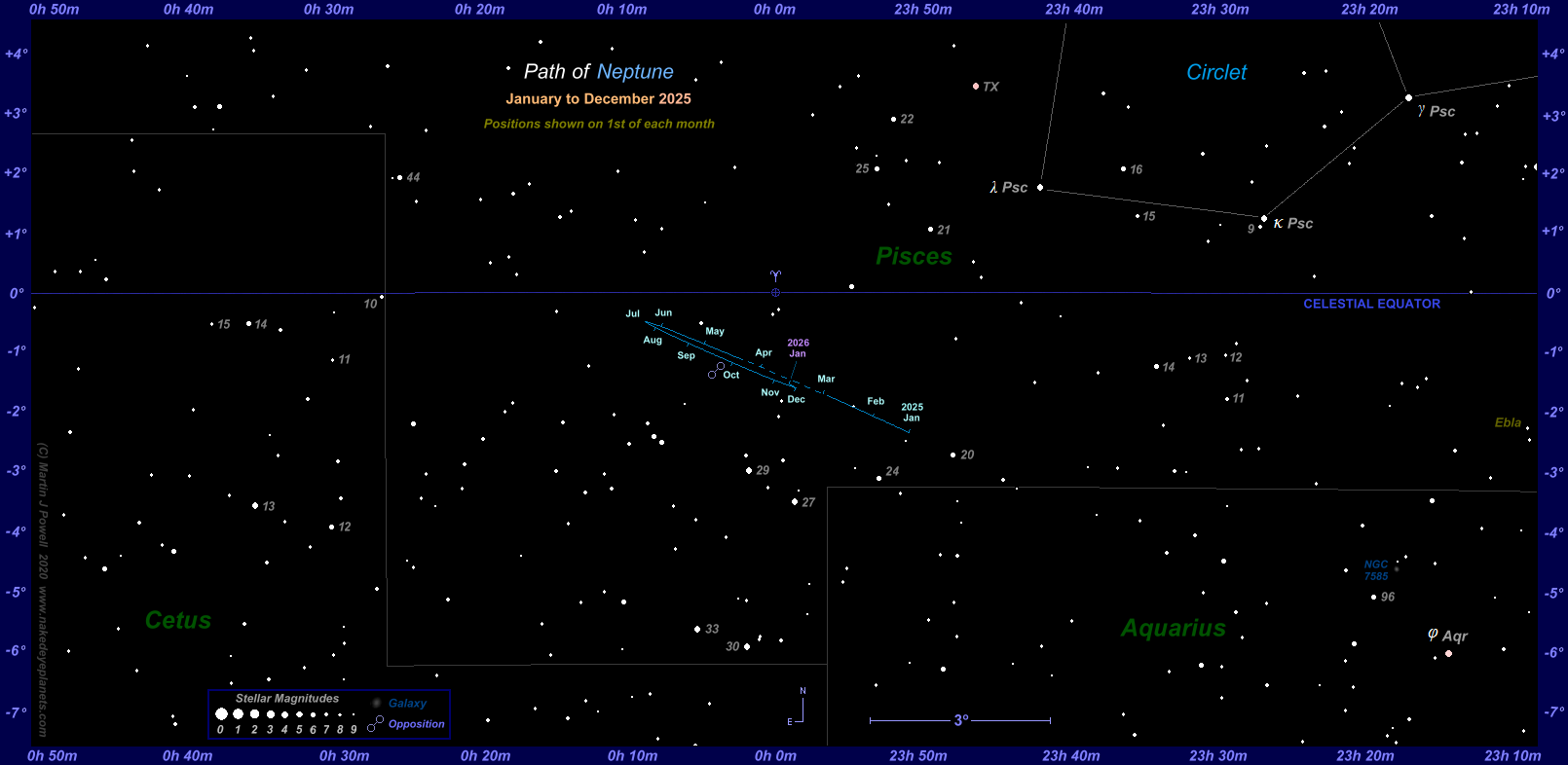
| The path of Neptune in South-western Pisces during 2025, with positions marked on the first day of each month (click on the thumbnail for the full-size image). A Southern hemisphere view can be found here. Where the planet was too close to the Sun to observe, the path is shown as a dashed line. Ideally, searches for Neptune should be carried out on Moonless nights, i.e. in the two-week period centred on the New Moon in any given month. Neptune
reached opposition to the Sun on September 23rd 2025
(indicated
on the chart by the symbol Stars are shown down to magnitude +8.5. Right Ascension and Declination co-ordinates are marked around the border. Printer-friendly (greyscale) versions of the chart are available for Northern and Southern hemisphere views. Click here to see a star map of the area without planet path; a printable version can be found here. |
|
|
Credits
Copyright Martin J Powell 2023-2025


 Neptune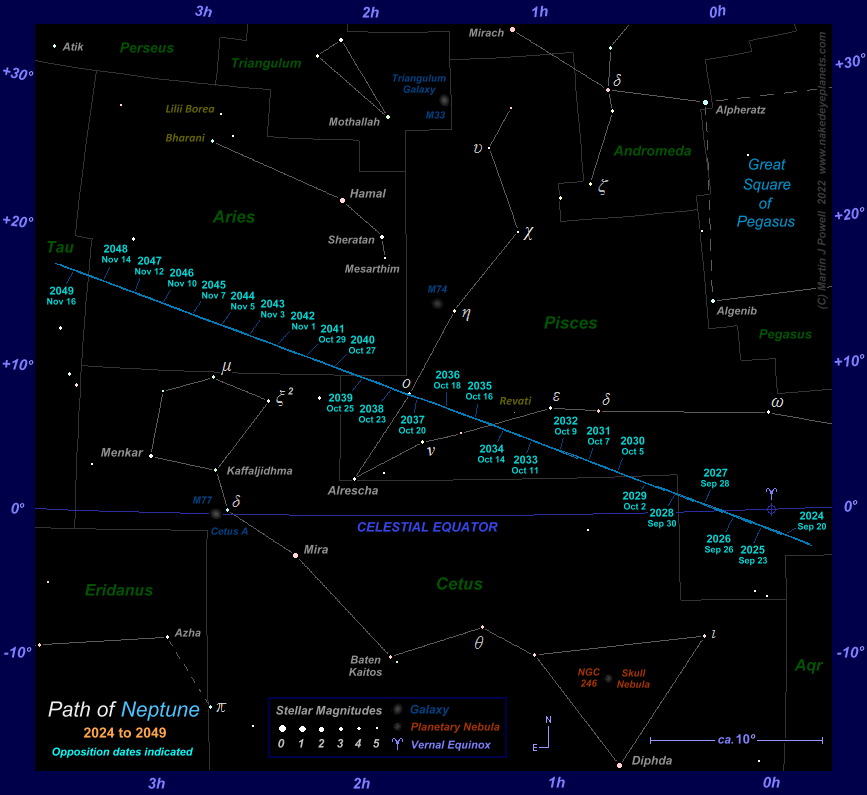
 ) when
it was magnitude +7.8 and its apparent diameter was 2".4 (2.4 arcseconds). The planet was then 28.884
Astronomical Units (4,321 million kms or 2,685 million miles) from Earth.
) when
it was magnitude +7.8 and its apparent diameter was 2".4 (2.4 arcseconds). The planet was then 28.884
Astronomical Units (4,321 million kms or 2,685 million miles) from Earth.