|
|
|
Current Positions of the Planets in the Night Sky:
The Jupiter-Uranus Triple Conjunction,
June 2010 to January 2011
by Martin J. Powell
As Jupiter and Uranus passed each other in the constellation of Pisces from 2010 to 2011, they underwent a series of three conjunctions (i.e. they reached the same celestial longitudes) over a seven-month period; this is referred to as a triple conjunction, and they are relatively rare events (the last one between Jupiter and Uranus took place in 1983). An animation demonstrating the principle of the triple conjunction - and showing how conjunction dates are defined - is provided in the information box below.
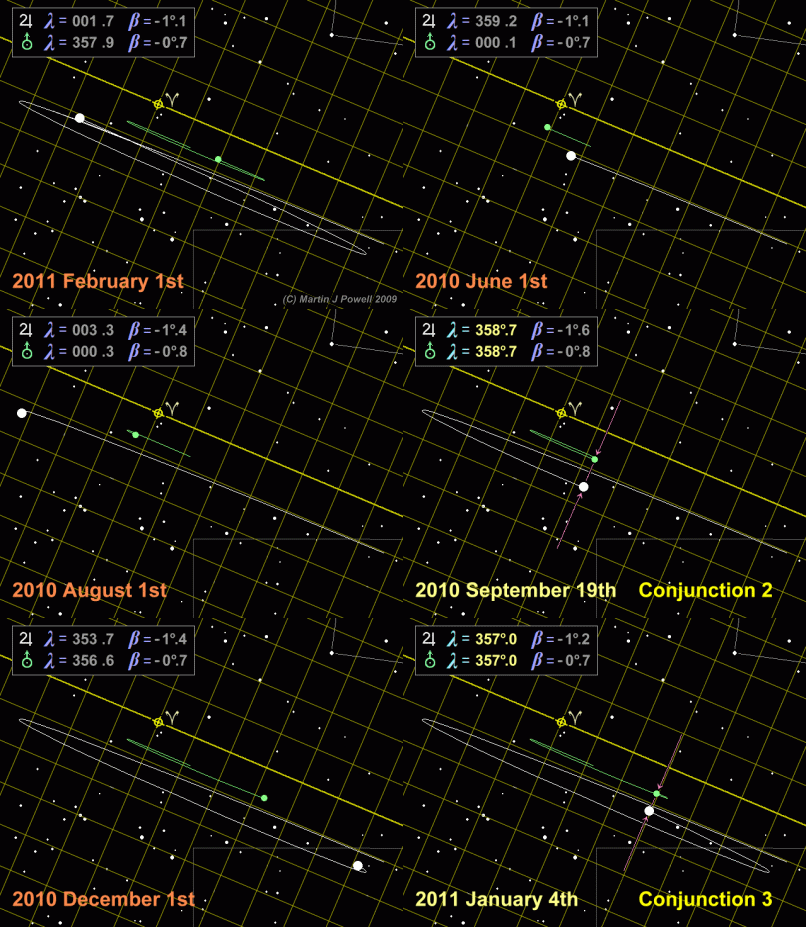
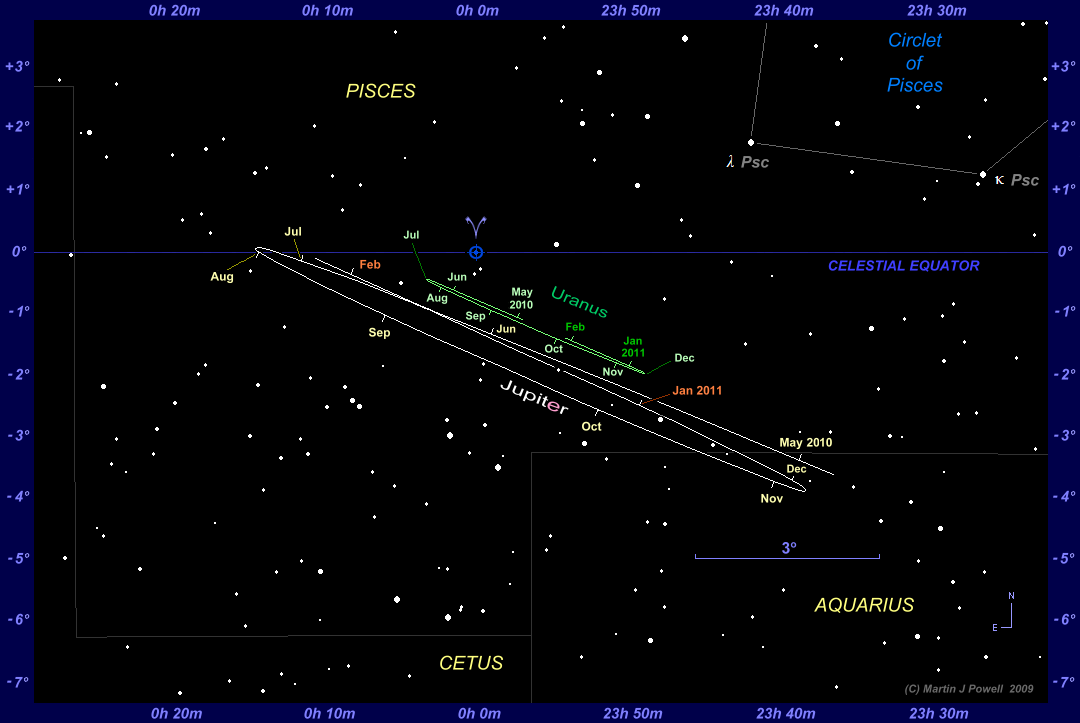
The first of the 2010-11 conjunctions took place on June 6th 2010, when both Jupiter (at an apparent magnitude of -2.3) and Uranus (at magnitude +5.9) were moving direct (or prograde, i.e. West to East) against the star background. The two planets were separated vertically by 29' (29 arcminutes, or just under half a degree) at this point, and were visible in the early morning sky. The second conjunction took place on September 22nd 2010, when both Jupiter (mag. -2.9) and Uranus (mag. +5.7) were retrograding (moving East to West) against the star background; the planets were separated by 53' (0°.88) at this point, and were visible throughout the night. This is also the day on which both planets reached opposition to the Sun, there being just 5 hours separating the two planets' opposition times (this is known as a paired opposition). Finally, the planets were again in conjunction on January 2nd 2011, when both Jupiter (-2.3) and Uranus (+5.9) had resumed direct motion, the pair then being separated by 34' (0°.56); this conjunction was visible in the evening sky, shortly after sunset.
The next triple conjunction between these two planets will be in 2037-8, when they are both in Gemini. Conjunctions of any kind between these two planets (mostly single or double) occur, on average, about every 13.7 years. The next will be on April 20th 2024 (single, in Aries); this conjunction will be difficult to see because the two planets will be close to the Sun at the time. The next meeting of the two planets after this will be the aforementioned triple conjunction (September 8th 2037, February 19th 2038 and March 30th 2038). All three of these conjunctions will be easy to see.
|
How are Planetary Conjunction dates determined? There are two ways of determining a planetary conjunction date: one is measured in Right Ascension (i.e. along the celestial equator) and the other is measured along the ecliptic, which is inclined at 23½° to the Earth's equatorial plane (this is due to the tilt of the Earth's axis in space). The conjunction dates determined by each method can differ by up to several days, depending upon the positions of the planets involved and their relative angular motions. Both of these methods are demonstrated in the diagrams below, which animate the Jupiter-Uranus triple conjunction of 2010-11. |
||
|
|
|
|
|
|
Note that, at the June 2010 conjunction, the date using the ecliptic longitude method is two days later than that measured using the RA method. At the September 2010 conjunction it is three days earlier than that of the RA method and at the January 2011 conjunction it is again two days later. The conjunction dates determined by each method differ by their greatest extent when the relevant planets are positioned in the vicinity of Pisces and Virgo, i.e. the constellations in which the ecliptic intersects with the celestial equator (the situation for Pisces being illustrated above). Although conjunction dates determined using the ecliptic longitude method are technically more accurate (separations between planets can be significantly closer) the Right Ascension method is the more commonly used, and it is the one which the writer has adopted here when quoting conjunction dates in the main text. |
|
|
Finding Uranus from Jupiter, May 2010 to February 2011
During 2010-2011 the bright planet Jupiter passed Uranus while in Pisces, describing its significantly larger planetary 'loop' about one apparent Full Moon-diameter to the South of Uranus. Since Jupiter is such an easy naked-eye object, the close approach of the two planets during this interval provided a good opportunity to find Uranus with relative ease; a finder chart appears below.
|
|
| Paths of Jupiter and Uranus, in South-western Pisces, marked on the first day of each month for the period from May 2010 to February 2011. Stars are shown down to magnitude +8.5. Right Ascension and Declination co-ordinates are marked around the border, for cross-referencing in a star atlas. A Southern hemisphere view can be found here. Printer-friendly (greyscale) versions of the chart are available for Northern and Southern hemisphere views. Click here to see a 'clean' star map of the area (i.e. without planet paths); a printable version can be found here. Three conjunctions between these planets took place during the period indicated on the chart, i.e. on June 6th 2010, September 22nd 2010 (opposition day) and January 2nd 2011. On these dates, a line drawn vertically through the two planets (i.e. in relation to Celestial North) show them to be in alignment. The apparent magnitudes of selected stars in the region (down to magnitude +8.5) are shown in brackets in this chart. |
Credits
Copyright Martin J Powell February 2009
|
Site
hosted by |


 )
in
the above diagram. The First Point of Aries is the
point at which the Sun crosses the celestial equator, heading Northwards,
at the Vernal Equinox (Spring equinox) on March 21st/22nd
of each year.
)
in
the above diagram. The First Point of Aries is the
point at which the Sun crosses the celestial equator, heading Northwards,
at the Vernal Equinox (Spring equinox) on March 21st/22nd
of each year. )
and Uranus (
)
and Uranus ( )
are shown in the inset box. The star map is overlaid with a grid
marking 1° intervals in RA (equivalent to four minutes of time)
and Declination (degrees North or South of the celestial
equator).
)
are shown in the inset box. The star map is overlaid with a grid
marking 1° intervals in RA (equivalent to four minutes of time)
and Declination (degrees North or South of the celestial
equator).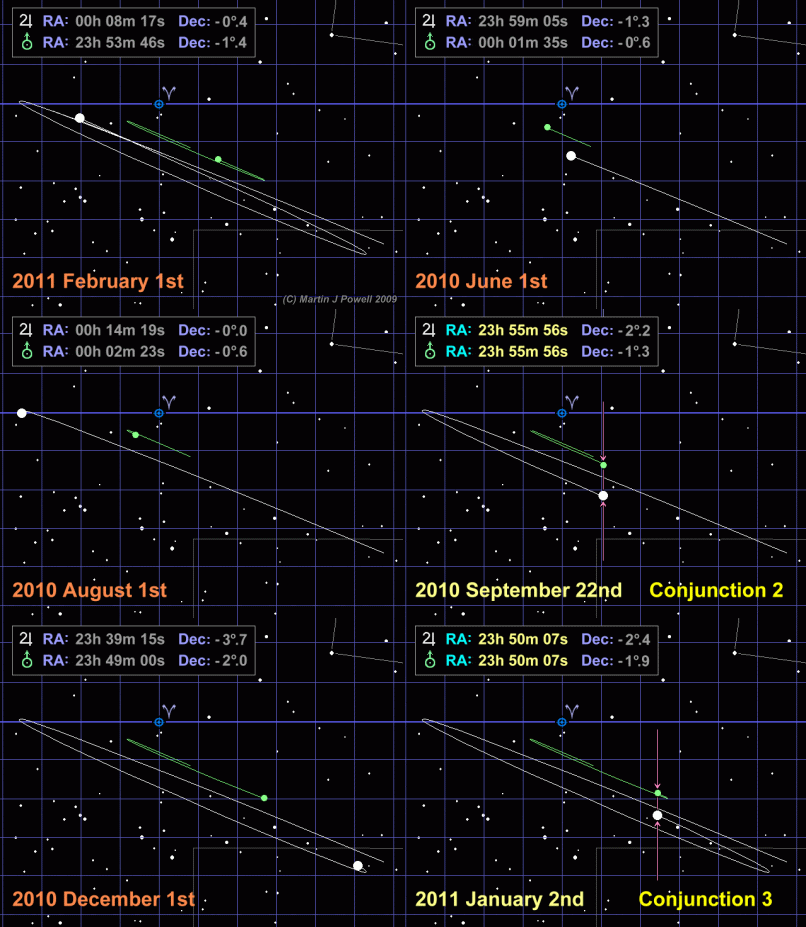
 )
and ecliptic latitude (degrees North or South of the ecliptic,
symbol
)
and ecliptic latitude (degrees North or South of the ecliptic,
symbol  ). A single-frame
enlargement of this chart showing the ecliptic latitude and
longitude in the South-western Pisces region
can be seen
). A single-frame
enlargement of this chart showing the ecliptic latitude and
longitude in the South-western Pisces region
can be seen