|
|
|
|
|
|
|
|
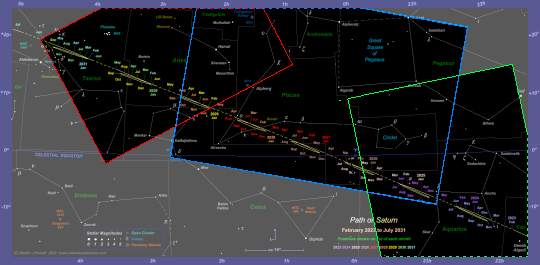
The path of Saturn against the background stars of Aquarius, Pisces, Aries and Taurus from February 2023 to July 2031, with positions marked on the first day of each month (click on the thumbnail for the full-size chart). The dates are colour-coded by year; a quick-glance legend is towards the lower right (e.g. all 2028 positions are shown in orange). Periods when the planet is unobservable (when it is too close to the Sun, or passes behind it) are indicated by a dashed line; hence Saturn becomes lost from view (in the evening sky) in early April 2028 and becomes visible again (in the morning sky) in early May 2028. The star map applies to observers in the Northern hemisphere (i.e. North is up); for the Southern hemisphere view, click here. The faintest stars on the map have
an apparent
magnitude
of about
+4.8.
Printer-friendly versions of this chart are available
for Northern
and Southern
hemisphere views. Astronomical co-ordinates of Right Ascension
(longitude, measured Eastwards in
hrs:mins from the First Point of Aries,
shown on the map by the symbol The chart shows the changing shape of Saturn's apparent looping formation as it moves through the zodiac, from shallow loops in Aquarius between 2023 and 2025 to more open loops for much of the rest of the period. For a fuller description of the planets' apparent loops against the background stars, refer to the Planet Movements page. Star names shown in yellow-green were officially adopted by the International Astronomical Union (IAU) in 2017. Three of the four such names shown on this chart were drawn from Hindu and Mayan mythology (for more details see the IAU's Working Group on Star Names pages). |
The Position of Saturn in the Night Sky:
2023 to 2031
by Martin J. Powell
Having spent almost three years in the constellation of Capricornus, the Sea-Goat, Saturn heads out of view in the dusk sky in late January 2023, positioned close to the constellation's Eastern border with Aquarius, the Water-Bearer. The planet enters Aquarius in mid-February of that year, being too close to the Sun to observe at this time.
Saturn
emerges into the
morning sky - rising in the Eastern sky at dawn - in early March 2023 at the start of its 2023-24 apparition,
positioned a short distance to the NNE of the star  Aqr (Iota Aquarii, apparent
magnitude +4.2).
During this apparition Saturn
describes
a flattened Southward-facing loop in central Aquarius,
positioned some 10° to the South of the constellation's most identifiable
asterism (star pattern) known informally as The
Steering Wheel.
The planet reaches its Eastern stationary
point in mid-June
2023 before turning retrograde
(moving East to West) and reaching opposition
(its closest and brightest orbital position in relation to the Earth for that
year) in late August 2023, positioned about 4° to the South-east of the star Ancha (
Aqr (Iota Aquarii, apparent
magnitude +4.2).
During this apparition Saturn
describes
a flattened Southward-facing loop in central Aquarius,
positioned some 10° to the South of the constellation's most identifiable
asterism (star pattern) known informally as The
Steering Wheel.
The planet reaches its Eastern stationary
point in mid-June
2023 before turning retrograde
(moving East to West) and reaching opposition
(its closest and brightest orbital position in relation to the Earth for that
year) in late August 2023, positioned about 4° to the South-east of the star Ancha ( Aqr
or Theta Aquarii, mag. +4.1).
Saturn continues
its Westward motion thereafter, reaching its Western stationary point in early November
of that year. It then
regains direct
motion (West to East), remaining visible for a further 3½ months before
heading out of view in the dusk twilight in mid-February 2024.
Aqr
or Theta Aquarii, mag. +4.1).
Saturn continues
its Westward motion thereafter, reaching its Western stationary point in early November
of that year. It then
regains direct
motion (West to East), remaining visible for a further 3½ months before
heading out of view in the dusk twilight in mid-February 2024.
|
|
|
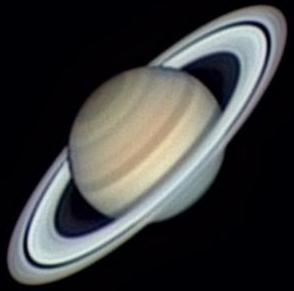
Saturn imaged by Nobuya Minagawa (Tokyo, Japan) on August 4th 2021 when the planet was two days past opposition. Minagawa used a 235mm (9¼-inch) Schmidt-Cassegrain reflector telescope fitted with a CMOS camera (Image: Nobuya Minagawa / ALPO-Japan) |
Saturn
re-emerges into
the dawn sky in mid-March 2024, heralding the start of its 2024-25 apparition,
positioned a short distance to the SSE of the star  Aqr (Lambda Aquarii, mag. +5.8).
The planet describes
another flattened South-facing loop in North-eastern Aquarius,
located to the SSW of the Circlet
of Pisces,
the most identifiable asterism of the neighbouring constellation Pisces,
the Fishes. Saturn reaches its Eastern stationary
point at the end of June 2024 before turning retrograde and reaching opposition
in the second week of September, positioned about 2° to the South-west of the
star
Aqr (Lambda Aquarii, mag. +5.8).
The planet describes
another flattened South-facing loop in North-eastern Aquarius,
located to the SSW of the Circlet
of Pisces,
the most identifiable asterism of the neighbouring constellation Pisces,
the Fishes. Saturn reaches its Eastern stationary
point at the end of June 2024 before turning retrograde and reaching opposition
in the second week of September, positioned about 2° to the South-west of the
star  Aqr (Phi Aquarii, mag. +4.2).
The planet continues its Westward motion,
reaching its Western stationary point in mid-November of that year. It then
regains direct
motion, remaining visible for a little over three months before heading out
of view in the dusk sky in late February 2025.
Aqr (Phi Aquarii, mag. +4.2).
The planet continues its Westward motion,
reaching its Western stationary point in mid-November of that year. It then
regains direct
motion, remaining visible for a little over three months before heading out
of view in the dusk sky in late February 2025.
The ringed planet emerges into the morning sky in late March 2025 at the start of its 2025-26 apparition, positioned in North-eastern Aquarius, about a degree South of its border with Pisces. Now being only a short distance South of the celestial equator (where the declination of a celestial body is 0°), Saturn rises close to due East and sets close to due West throughout this apparition. Saturn enters Pisces in mid-April 2025, describing its 2025-26 South-facing loop on the border between the two constellations. The planet reaches its Eastern stationary point in mid-July 2025, positioned some 3° to the ESE of the First Point of Aries (the Sun's Vernal equinox point). Saturn turns retrograde and reaches opposition in the third week of September, positioned only 21' (0°.35) away from the Piscean border with Aquarius. Since its rings are now almost edgewise-on to the Earth, it is Saturn's dimmest opposition since 2010. Saturn continues Westward, crossing back into Aquarius nine days after opposition, reaching its Western stationary point in late November 2025. It then regains direct motion, crossing back into Pisces in mid-January 2026 and remaining visible for a further seven weeks before heading out of view in the evening sky in early March 2026. Whilst out of view, in late March, Saturn crosses to the North of the celestial equator and two weeks later enters the non-zodiacal constellation of Cetus, the Whale.
Saturn's
2026-27 apparition commences with its first appearance in the dawn sky in mid-April
2026, positioned near the North-western corner of Cetus.
The planet's South-facing loop is described mostly in Cetus,
with a partial overlap in Pisces;
Saturn's
position close to the celestial equator means that it will continue
to rise near due East and set near due West throughout the apparition.
The planet re-enters Pisces
through its Southern border whilst moving direct (North-eastwards) at the start
of June 2026, reaching its Eastern stationary point in late July.
It then turns retrograde and heads back into Cetus
in the first week of September, reaching opposition in that constellation in early October,
positioned about 6° to the SSW of the star  Psc (Delta Piscium, mag. +4.4).
Saturn
then continues retrograde motion, reaching its Western stationary point in mid-December, about a degree North of the celestial equator. It then resumes
direct motion and re-enters Pisces in
the final week of February 2027. A month later Saturn
heads out of view
in the dusk twilight.
Psc (Delta Piscium, mag. +4.4).
Saturn
then continues retrograde motion, reaching its Western stationary point in mid-December, about a degree North of the celestial equator. It then resumes
direct motion and re-enters Pisces in
the final week of February 2027. A month later Saturn
heads out of view
in the dusk twilight.
Saturn
re-appears in the dawn sky in late April 2027 at the start of its 2027-28 apparition,
located towards the 'tail-end' of Pisces.
The planet is now a couple of degrees South of Revati
( Psc or Zeta Piscium, mag. +5.2), a star which was formerly assigned
this name by the
International Astronomical Union (IAU) in 2017.
Saturn's open,
South-facing loop is described between the tails of the Fishes, the planet reaching
Eastern stationary point in mid-August 2027, a degree South of
the star Torcular (
Psc or Zeta Piscium, mag. +5.2), a star which was formerly assigned
this name by the
International Astronomical Union (IAU) in 2017.
Saturn's open,
South-facing loop is described between the tails of the Fishes, the planet reaching
Eastern stationary point in mid-August 2027, a degree South of
the star Torcular ( Psc or Omicron Piscium, mag. +4.2). The planet turns retrograde
and reaches opposition in mid-October in the tail of the Southern Fish,
positioned a degree North-east
of the star
Psc or Omicron Piscium, mag. +4.2). The planet turns retrograde
and reaches opposition in mid-October in the tail of the Southern Fish,
positioned a degree North-east
of the star  Psc (Mu
Piscium, mag. +4.8)
. Continuing South-westwards Saturn reaches
its Western stationary point in the fourth week of December,
positioned a few degrees West of
Psc. After
returning to direct motion the planet heads out of view some 3½ months later
at the start of April 2028, by this time located a short distance East of Torcular.
Psc (Mu
Piscium, mag. +4.8)
. Continuing South-westwards Saturn reaches
its Western stationary point in the fourth week of December,
positioned a few degrees West of
Psc. After
returning to direct motion the planet heads out of view some 3½ months later
at the start of April 2028, by this time located a short distance East of Torcular.
|
|
|
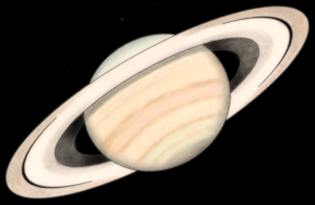
Saturn sketched by Paul G Abel (Leicester, UK) in August 2021, one day past opposition. Abel observed the planet using a 305mm (12-inch) Newtonian reflector telescope at 150x and 188x magnifications (Image: Paul G Abel / ALPO-Japan) |
When
Saturn returns
to view in the morning sky in the second week of May 2028, it is just approaching the three-way
border between Pisces,
Cetus and
Aries,
the Ram, the latter of which the planet enters a few days later. Saturn's
2028-29 open, South-facing loop is described in South-western Aries,
just touching its border with Cetus.
The planet reaches Eastern stationary point in the final week of August 2028
in central Southern Aries,
retrograding to an opposition at the end of October, positioned about a degree
to the North of the star  Ari (Xi Arietis, mag. +5.4).
Saturn's South-westward
motion carries it back into Cetus
in the third week of December 2028, its Western stationary point being reached
in early January 2029, precisely on the border between Aries and
Cetus.
On re-entering Aries the
ringed planet proceeds in direct motion North-eastwards, heading out of view in the dusk sky
some 3½ months later in mid-April 2029.
Ari (Xi Arietis, mag. +5.4).
Saturn's South-westward
motion carries it back into Cetus
in the third week of December 2028, its Western stationary point being reached
in early January 2029, precisely on the border between Aries and
Cetus.
On re-entering Aries the
ringed planet proceeds in direct motion North-eastwards, heading out of view in the dusk sky
some 3½ months later in mid-April 2029.
Saturn returns
to view in the dawn sky in the final week of May 2029, heralding the start of
the planet's 2029-30 apparition. Its open, South-facing loop is mostly described in
South-eastern Aries,
with a three-month occupancy of neighbouring Taurus,
the Bull.
The planet crosses into Taurus in the fourth week of July 2029, reaching Eastern stationary point in
the first week of September, positioned about 4° North of the star 5
Tau (5 Tauri, mag. +4.1). Retrograde motion carries the ringed planet
back into Aries in
the fourth week of October, reaching its opposition in mid-November, positioned
some 4° to the SSE of the
star Botein (
Ari or Delta Arietis, mag. +4.3). Western stationary point is reached
in the third week of January 2030, 5° to the SSW of
Botein. On returning to direct motion Saturn re-enters
Taurus
in the second week of April, heading out of view in the dusk sky by the end
of that month.
Saturn re-appears
in the morning sky in early June 2030, positioned about 6° to the SSE
of the star cluster known as the Pleiades or
Seven Sisters (Messier
45 or M45),
Taurus'
most famous asterism.
Now positioned in the Northernmost constellation of the zodiac,
the planet rises close to its most Northerly point on the local horizon
(North-east at
higher Northern and higher Southern latitudes and towards the ENE at latitudes
in-between) and will continue to
do so throughout its 2030-31 apparition. Saturn's
shallow, South-facing loop is described just to the North-west of the Bull's
other famous asterism: the Hyades,
a distinct 'V'-shaped grouping of stars which form the head of the Bull. The
planet reaches its Eastern stationary point in
the third week of September 2030, located about half a degree North of the star
Ain ( Tau or Epsilon Tauri , mag. +3.5) which marks the Northern 'eye'
of the Bull figure. Saturn
retrogrades Westwards to an opposition in late November, positioned about 2° to
the North-west of the star Secunda Hyadum (1
Tau or Delta-1 Tauri, mag. +3.7) in the
Hyades.
Saturn now
sets towards the North-west at higher Northern and higher Southern latitudes
and towards the WNW at latitudes in-between. Western stationary point
is reached in early February 2031, some 6° to the South-east of the Pleiades.
On turning direct the planet passes to the North of the Hyades
over the next few months, heading out of view in the dusk sky around mid-May 2031.
Tau or Epsilon Tauri , mag. +3.5) which marks the Northern 'eye'
of the Bull figure. Saturn
retrogrades Westwards to an opposition in late November, positioned about 2° to
the North-west of the star Secunda Hyadum (1
Tau or Delta-1 Tauri, mag. +3.7) in the
Hyades.
Saturn now
sets towards the North-west at higher Northern and higher Southern latitudes
and towards the WNW at latitudes in-between. Western stationary point
is reached in early February 2031, some 6° to the South-east of the Pleiades.
On turning direct the planet passes to the North of the Hyades
over the next few months, heading out of view in the dusk sky around mid-May 2031.
Saturn returns to view in the dawn sky in the third week of June 2031, exiting the star map in the following month as it passes between the horns of the Bull.
Opposition Data
Saturn reaches opposition to the Sun (when it is closest to the Earth and brightest in the sky for the year) every 378 days on average, i.e. about 13 days later in each successive year. Around opposition, Saturn is due South at local midnight in the Northern hemisphere (due North at local midnight in the Southern hemisphere). Details of the eight Saturnian oppositions covered by the above star map are given in the table below. Note how the planet's appearance changes slightly at each opposition, the ring system displaying varying tilt angles to the Earth as it orbits the Sun (for more details, see the diagram of Saturn's orbit). Like the other Solar System planets, Saturn's apparent size (its angular diameter as seen from the Earth) varies slightly at each opposition because its orbit is slightly elliptical.
The dates on which Saturn reaches superior conjunction (i.e. when it passes behind the Sun as seen from the Earth) are also shown in the table. The planet is not normally visible from the Earth for about two weeks on either side of these dates.
|
Apparition Period |
Opposition Circumstances |
Superior Conjunction |
||||||||||
|
Opposition Date |
Constellation |
Declination |
Apparent Magnitude |
Diameter (arcsecs) |
Ring Tilt |
View from Earth (North up) |
Distance (AU)* |
|||||
|
Globe |
Ring |
from Earth |
from Sun |
|||||||||
|
2023/24 |
2023 Aug 27 |
|
Aqr |
-11°.7 |
+0.3 |
19".0 |
43".0 |
+9°.0 |
|
8.7629 |
9.7729 |
2024 Feb 28 |
|
2024/25 |
2024 Sep 8 |
|
Aqr |
-7°.5 |
+0.4 |
19".2 |
43".5 |
+3°.7 |
|
8.6580 |
9.6647 |
2025 Mar 12 |
|
2025/26 |
2025 Sep 21 |
|
Psc |
-2°.9 |
+0.5 |
19".4 |
43".9 |
-1°.8 |
|
8.5467 |
9.5498 |
2026 Mar 25 |
|
2026/27 |
2026 Oct 4 |
|
Cet |
+1°.9 |
+0.5 |
19".7 |
44".6 |
-7°.4 |
|
8.4342 |
9.4336 |
2027 Apr 7 |
|
2027/28 |
2027 Oct 18 |
|
Psc |
+6°.8 |
+0.3 |
20".0 |
45".3 |
-12°.8 |
|
8.3260 |
9.3213 |
2028 Apr 20 |
|
2028/29 |
2028 Oct 30 |
|
Ari |
+11°.5 |
+0.0 |
20".2 |
45".8 |
-17°.8 |
|
8.2275 |
9.2194 |
2029 May 4 |
|
2029/30 |
2029 Nov 13 |
|
Ari |
+15°.7 |
-0.1 |
20".4 |
46".2 |
-22°.0 |
|
8.1444 |
9.1331 |
2030 May 19 |
|
2030/31 |
2030 Nov 27 |
|
Tau |
+19°.1 |
-0.3 |
20".6 |
46".7 |
-25°.0 |
|
8.0815 |
9.0677 |
2031 Jun 3 |
|
* 1 AU (Astronomical Unit) = 149,597,870 kms (92,955,807 statute miles) |
|
Saturn opposition data for the period 2023 to 2030. The Declination is the angle of the planet to the North (+) or South (-) of the celestial equator; on the star chart, it represents the planet's angular distance above or below the blue line. The angular diameter (or apparent size) of the planet as seen from Earth is given in arcseconds (where 1 arcsecond = 1/3600th of a degree). Note that Saturn's distance at each opposition slowly reduces through to 2032, causing its angular diameter to increase slightly year by year. Saturn's apparent magnitude (brightness) reaches a minimum when the Earth passes through the planet's ring-plane in 2025 and begins to brighten again thereafter; it will reach a 'peak' in 2032 when the rings are almost fully open. The Ring Tilt (the ring plane opening angle to the Earth) is positive (+) when Saturn's Northern hemisphere is tipped towards the Earth and negative (-) when the planet's Southern hemisphere is tipped towards the Earth; the maximum value it can attain is ±27°.0. The Ring Tilt values were obtained from the SETI Institute's Saturn Ephemeris Generator 3.0. All other data was obtained from the software 'Redshift', the 'SkyGazer Ephemeris' utility and the 'Cielo e Terra' website. The Saturn images were modified by the writer from Kyle Edwards' Solar System Imaging Simulator. |
Ring System
Saturn's rings last appeared edge-on to the Earth in 2025, when the Earth passed through the planet's ring plane, following which their Southern face came into view. The Northern face will come into view after the Earth's next crossing of the planet's ring plane in 2038-39.
The rings were previously fully open to the Earth in late 2017, at which time Saturn's Northern hemisphere was tipped in our direction. They will next be fully open in 2032, when the planet's Southern hemisphere is tipped in our direction.
By a stroke of good luck on nature's part, Saturn's perihelion (its closest orbital point to the Sun) takes place only a short while after the planet's Southern pole is tilted at its greatest angle towards the Earth, so at these times - namely, every 29½ years - we are treated to a splendid, 'close-up' view of both the globe and the ring system when seen through Earthbound telescopes. Saturn last passed perihelion in 2003 and will next pass it in late 2032, when it will be 9.015 Astronomical Units (838 million miles or 1,348 million kms) from the Sun.
For Northern hemisphere observers the situation is even better: whenever it is near perihelion, Saturn rides high in the sky on the Taurus/Gemini border, giving the best possible observing conditions for telescopic observers; this will next happen in mid-2033.
Saturn will reach aphelion (its furthest orbital point from the Sun) in Sagittarius in 2047, when it will be 10.046 AU (1,503 million kms or 934 million statute miles) from the Sun. Southern hemisphere observers will then be ideally placed to observe the fully-open Northern face of the rings. The planet will reach its most Southerly point in the zodiac in the following year.
[Terms in yellow italics are explained in greater detail in an associated article describing planetary movements in the night sky.]
Saturn Conjunctions with other Planets, 2023 to 2025
Viewed from the orbiting Earth, whenever two planets appear to pass each other in the night sky (a line-of-sight effect) the event is known as a planetary conjunction or appulse. Not all planetary conjunctions will be visible from the Earth, however, because many of them take place too close to the Sun. Furthermore, not all of them will be seen from across the world; the observers' latitude will affect the altitude (angle above the horizon) at which the two planets are seen at the time of the event and the local season will affect the sky brightness at that particular time. A flat, unobstructed horizon will normally be required to observe most of them.
The majority of conjunctions involving Saturn are not particularly spectacular to view because the planet is usually positioned far away from the Earth and is therefore not especially bright - Saturn looking like an ordinary, pale-yellow star. Those involving Venus will always take place at solar elongations of less than 47° from the Sun, whilst those involving Mercury will always take place at less than about 27° from the Sun. In both of these instances twilight is often a problem, the lighter sky diminishing the visual impact of the conjunction.
Saturn's most interesting conjunctions take place when the planet is within a few months of opposition - and is therefore very bright - at which times they involve either Jupiter or Mars; these events are however very rare. Most conjunctions between Saturn and Jupiter (or Saturn and Mars) occur at elongations of less than 90°, when Saturn is far from its brightest in any given apparition. Between 2023 and 2025, for example, only one conjunction was positioned more than 90° from the Sun, the majority taking place at solar elongations of less than 47°. In all cases, Saturn shone no brighter than a relatively dim apparent magnitude of +0.7, not only due to the planet's great distance but also because its ring aspect to the Earth narrowed significantly during the period.
|
|
The 2023-2025 period contained seven planetary conjunctions involving Saturn, five of which were in the morning sky and two of which were in the evening sky.
Five of the conjunctions were with Venus. The easiest to view was that on January 20th 2025, when Venus passed 2°.5 to the South of Saturn in the evening sky. The planets' location in Aquarius (not far from the celestial equator), together with the wide solar elongation of 47° (only ten days after Venus' greatest elongation day), meant that the conjunction was seen in darkness from across the inhabited world. As Saturn came into view in the dusk twilight, the pair were positioned 29° high in the SSW at 50° North, 39° high in the South-west at 30° North and 40° high in the West at the Equator. In the Southern hemisphere they were placed 30° high in the West (at 25° South), 23° high in the West (at 35° South) and 15° high in the West (at 45° South). At magnitude -4.4 Venus was close to its brightest, however Saturn was a poor magnitude +1.0, which was close to its dimmest since its rings were more or less edge-on to the Earth at this time.
The next best Venus-Saturn conjunction of the period was also in the evening sky on January 22nd 2023, when Venus (mag. -3.8) passed 22' (0°.36) South of Saturn (+0.7). Because of the fairly narrow solar elongation (22°), as the ringed planet came into view in the dusk twilight, the event was only seen at low altitude from across the world. At 50° North the pair were positioned at an altitude of only 10° above the South-western horizon, whilst at latitudes from 30° North to the Equator they were only 16° high in the WSW. As Saturn came into view in the Southern hemisphere, the pair were only 10° high in the West at 25° South and just 8° high in the WSW at 35° South.
The Venus-Saturn conjunction on the morning of April 29th 2025 was observable from latitudes South of the mid-Northern hemisphere. At 40° North the planets reached 13° above the ESE horizon when Saturn disappeared from view whilst at 20° North they were 25° high in the ESE. From the Equator Southwards the pair were positioned between 32° and 36° high (about 'one-third of the way up the sky') towards the East (Equator) or the North-east (45° South) at the ringed planet's disappearance.
The remaining two conjunctions between Venus and Saturn were more challenging to the naked-eye observer since they took place at solar elongations of less than 20°. The morning conjunction of March 22nd 2024 was only observable from South of the Northern Tropics, the pair at best reaching only 13° high in the Eastern sky at Saturn's disappearance. The 10°-wide dawn conjunction of March 30th 2025 took place at the start of both Saturn's 2025-26 apparition and Venus' 2025 morning apparition and was the most challenging of all of the seven conjunctions. On this occasion Venus was pulling away from the Sun and was moving retrograde just prior to looping through the Circlet of Pisces. This conjunction was followed a month later by a second with Saturn on April 29th (described above), by which time Venus was moving direct, having completed its loop and having left the Circlet of Pisces behind it. The conjunction was visible only between latitudes 7° North and about 45° South, the pair reaching only 8° above the Eastern horizon at Saturn's disappearance, the ringed planet being several degrees higher in altitude than Venus. The pair were seen in continuous twilight from latitudes South of about 30° South.
A morning conjunction between Saturn and Mars on April 11th 2024 was well-positioned for Southern hemisphere viewers. The pair were separated in the sky by 0°.5 (the apparent diameter of the Full Moon) and they shone at similar magnitudes (+0.9 and +1.1 respectively) which presented a good opportunity to compare the subtle colours of the two planets by naked-eye or with binoculars. As the fainter planet (Mars) disappeared from view in the dawn twilight the pair were positioned 20° high in the ESE in the Northern Tropics, 28° high in the East at the Equator, 31° high in the East at 25° South and 30° high in the ENE at 45° South. Before fading from view the planets were visible for around 40 minutes (at 25° North), 1¼ hours (Equator), 1¾ hours (25° South) and 2 hours (45° South).
The conjunction with the widest solar elongation (96°) was that between Saturn and Neptune on the morning of June 29th 2025. Since Neptune is the faintest of the observable planets in the night sky (in this case magnitude +7.9) optical aid is always required to observe it. Saturn was easily spotted among the faint stars of Southern Pisces, but a finder chart was required to locate Neptune with certainty. Although taking place close to the celestial equator, this conjunction favoured the Southern hemisphere, where local midwinter had just passed (in the Northern hemisphere midsummer had just passed, the bright twilight rendering the conjunction unobservable North of about 48° North). The planetary pair rose in darkness several hours before the Sun and were visible for a leisurely 3½ hours (at 30° North), 5 hours (Equator), 5½ hours (25° South) and 6 hours (45° South) before Neptune faded from view at first light. By this time the pair were positioned 45° high in the South-east at 30° North, 63° high in the East at the Equator, 65° high in the North at 25° South and 45° high in the North at 45° South. At latitudes South of about 32° South the pair had passed through due North (i.e. transited the meridian) by the time dawn arrived.
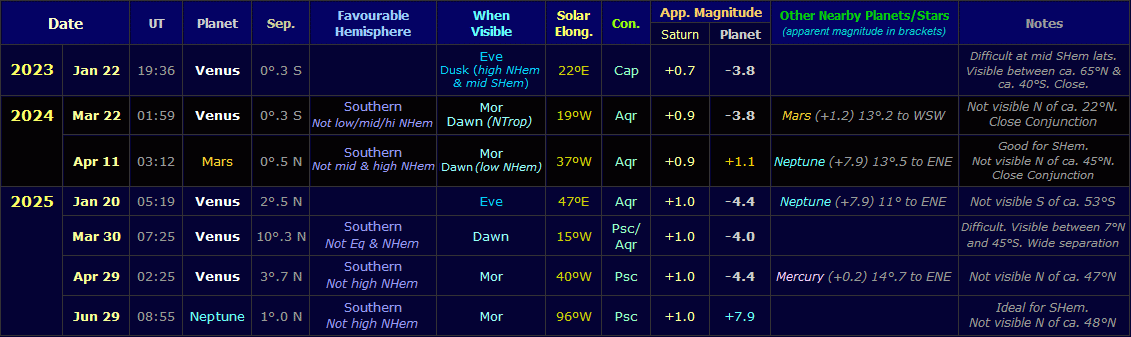
The following table details the conjunctions involving Saturn which took place at solar elongations of greater than 15° over the period in question. In several cases, other planets and/or stars were also in the vicinity and these are detailed. Note that, because some of the conjunctions occurred in twilight, the planets involved may not have appeared as bright as their listed magnitude suggests.
|
Saturn conjunctions with other planets from January 2023 to June 2025 The column headed 'UT' is the Universal Time (equivalent to GMT) of the conjunction (in hrs : mins). The separation (column 'Sep') is the angular distance between the two planets, measured relative to Saturn, hence on 2024 Apr 11, Mars was positioned 0°.5 North of Saturn at the time shown. The 'Favourable Hemisphere' column shows the Hemisphere in which the conjunction was best observed. Note that observers located close to the Northern/Southern visibility boundary of any given conjunction will have found it difficult or impossible to observe because of low altitude and/or bright twilight. In the 'When Visible' column, a distinction is made between Dawn/Morning visibility and Dusk/Evening visibility; the terms Dawn/Dusk refer specifically to the twilight period before sunrise/after sunset, whilst the terms Evening/Morning refer to the period after darkness falls/before twilight begins (some conjunctions take place in darkness, others do not, depending upon latitude). The 'Con' column shows the constellation in which the planets were positioned at the time of the conjunction. To find the direction in which any of the conjunctions were seen, note down the constellation in which the planets were located ('Con' column) on the required date and find the constellation's rising direction (for Dawn/Morning conjunctions) or setting direction (for Dusk/Evening conjunctions) for your particular latitude in the Rise-Set direction table. |
Although any given conjunction takes place at a particular instant in time, it is worth pointing out that, because of the planets' relatively slow daily motions, such events are interesting to observe for several days both before and after the actual conjunction date.
There are in fact two methods of defining a planetary conjunction date: one is measured in Right Ascension (i.e. perpendicular to the celestial equator) and the other is measured along the ecliptic, which is inclined at 23½° to the Earth's equatorial plane (this is due to the tilt of the Earth's axis in space). An animation showing how conjunction dates are determined by each method can be found on the Jupiter-Uranus 2010-11 triple conjunction page. Although conjunctions measured along the ecliptic can be significantly closer, the Right Ascension method is the more commonly used, and it is the one which is adopted here.
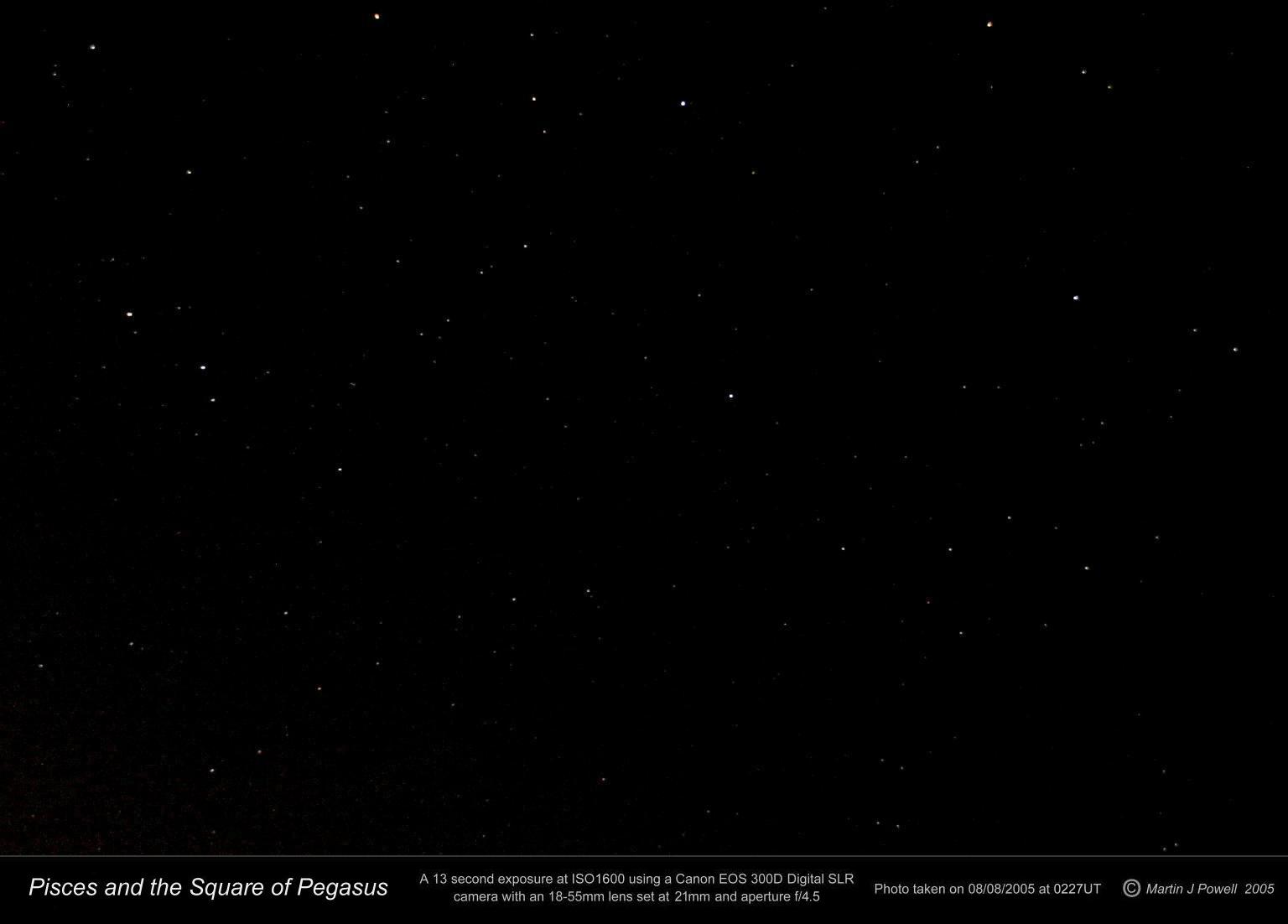
Constellation Photographs: Aquarius, Pisces, Aries and Taurus
|
|
|
|
|
|
|
|
Moon near Saturn Dates, 2026
On one or two days in each month, the Moon can be used as our celestial guide to help in locating Saturn in the sky. Use the following table to see on which dates the Moon is in the vicinity of the planet:
|
|
|||||||||||||||||||||||||||||||||||||||||||||||||||||||||||||||||||||||||
|
Moon near Saturn dates for 2026. The Date Range shows the range of dates worldwide (allowing for Time Zone differences across East and West hemispheres). Note that the dates, times and separations at conjunction (i.e. when the two bodies are at the same Right Ascension) are measured from the Earth's centre (geocentric) and not from the Earth's surface (times are given in Universal Time [UT], equivalent to GMT). The Sep. & Dir. column gives the angular distance (separation) and direction of the planet relative to the Moon, e.g. on May 13th at 21:57 UT, Saturn is positioned 5°.7 South of the Moon's centre. The Moon Phase shows whether the Moon is waxing (between New Moon and Full Moon), waning (between Full Moon and New Moon), at crescent phase (less than half of the lunar disk illuminated) or gibbous phase (more than half but less than fully illuminated). Moon near Saturn dates can also be viewed for 2023, 2024, 2025, 2027, 2028, 2029 and 2030. |
||||||||||||||||||||||||||||||||||||||||||||||||||||||||||||||||||||||||||
The Moon moves relatively quickly against the background stars in an Eastward direction, at about its own angular width (0º.5) each hour (about 12º.2 per day). Because it is relatively close to the Earth, an effect called parallax causes it to appear in a slightly different position (against the background stars) when seen from any two locations on the globe at any given instant; the further apart the locations, the greater the Moon's apparent displacement against the background stars. Therefore, for any given date and time listed in the table, the Moon will appear closer to Saturn when seen from some locations than from others. For this reason, the dates shown in the table should be used only for general guidance.
Saturn's Five Brightest Moons
Saturn's five brightest moons (satellites) - namely Titan (magnitude +8.3 at opposition), Rhea (+9.7), Tethys (+10.2), Dione (+10.4) and Enceladus (+11.7) - can easily be seen through telescopes, but only Titan (Saturn's largest moon) is visible through binoculars. The moons are seen to change their position in relation to each other from one night to the next.
Because of Saturn's relatively high axial tilt (26º.7 to the plane of its orbit) the Saturnian moons are mostly seen to follow apparent elliptical paths around the planet when viewed from the Earth (this is in contrast to, say, Jupiter's shallow axial tilt (3º.1), which causes its moons to present a more-or-less linear motion when seen from the Earth - see Jupiter's moon positions). However, the motion of Saturn's moons does appear more-or-less linear whenever the Earth crosses through the ring-plane of the planet. For about a year on either side of the ring-plane crossing date, transits (when a moon or its shadow passes across the planet's disk), occultations (when a moon passes behind the planet's disk) and eclipses (when a moon enters the planet's shadow) can be observed through telescopes. More rarely, these events can also happen between the moons themselves; the current series of such mutual events (or mutual phenomena) began in May 2024 and will end in May 2026.
The positions of Saturn's five brightest moons can be found using Sky & Telescope's Saturn Moons facility.
Positions of all five moons with an additional three - namely Iapetus (which varies between magnitudes +10.2 and +11.9 at opposition), Mimas (+12.9 at opposition) and Hyperion (+14.2 at opposition) - can be found at the BAA's Computing Section website.
|
|
Credits
Copyright Martin J Powell December 2022


 Saturn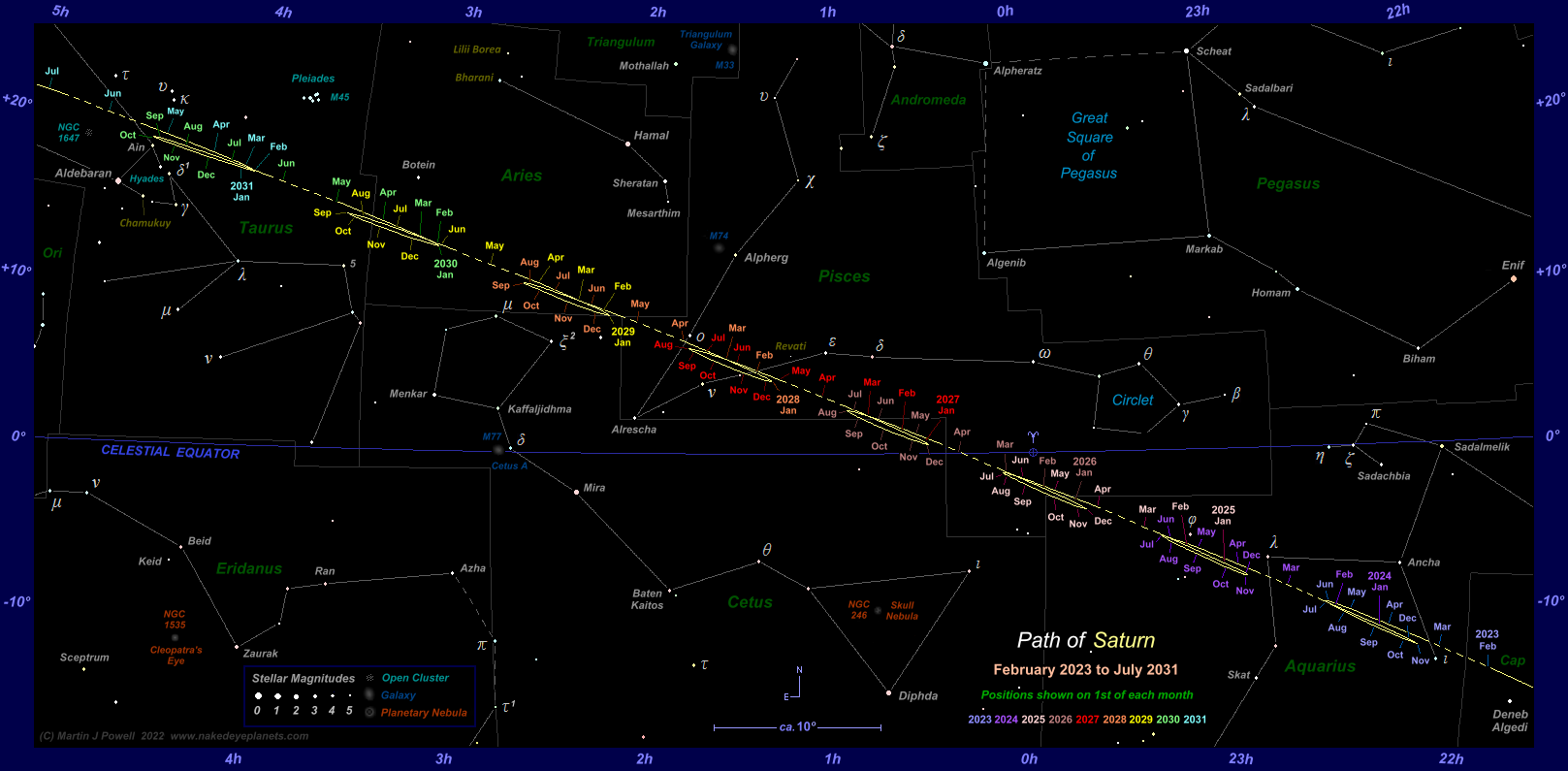
 )
and Declination
(latitude, measured in degrees North or South of the celestial
equator)
are marked around the border of the chart. Click
)
and Declination
(latitude, measured in degrees North or South of the celestial
equator)
are marked around the border of the chart. Click